





Space & Astronomy
August 17, 2026


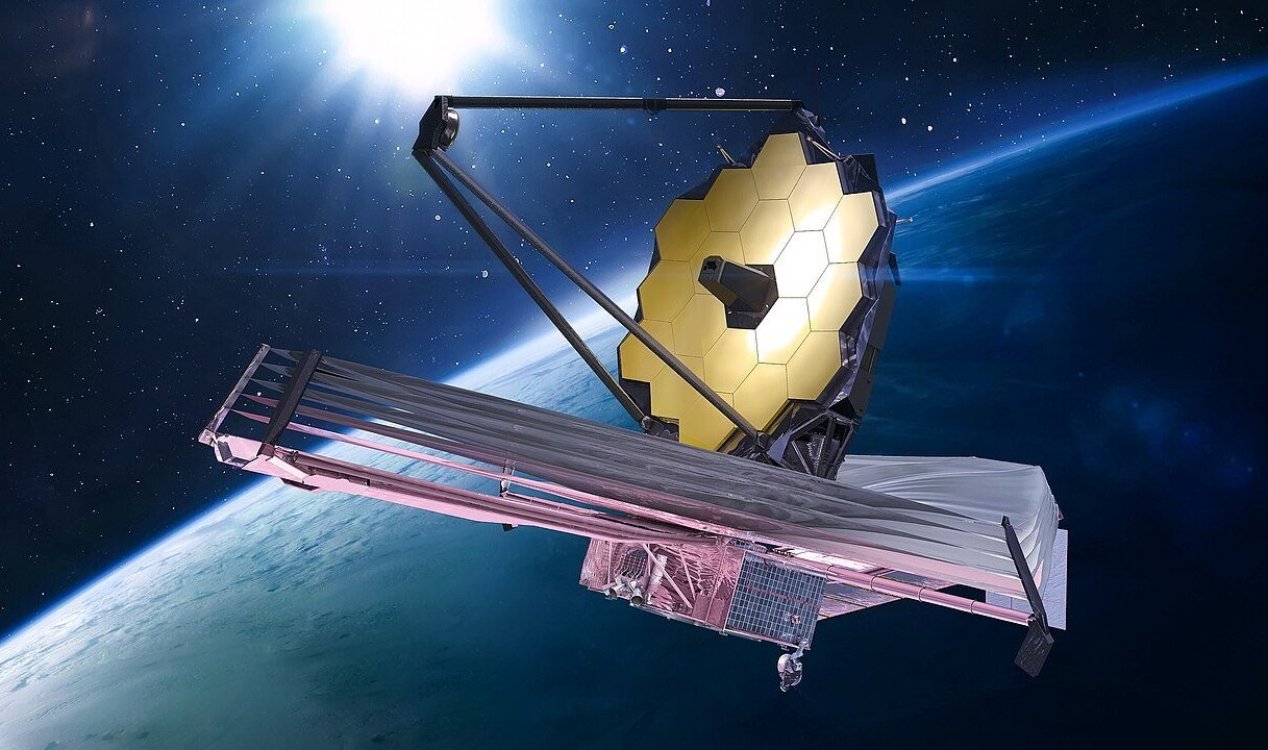
Image: James Webb Space Telescope
Credit: NASA/dima_zel/NOIRLab / CC BY 4.0 (adapted)
Spotted by NASA's James Webb Space Telescope, this distant anomaly is essentially an enormous star (comparable in size to our entire solar system) that is putting out 100 billion times more energy than any star should be able to.
Dating back to just a few hundred million years after the Big Bang, this object is now thought to be an amalgamation of a star and a black hole - something that has been dubbed a black hole star.
Most likely, it consists of a huge cloud of dense gas powered by a central black hole.
"Our picture of this object is evolving very rapidly," said lead study author Rohan Naidu.
"We think there is a central black hole that is 100,000 times as massive as the sun."
"And around this black hole, there would be this very extended envelope of gas that looks like a star the size of the solar system. It's huge."
Black hole stars seem to exist exclusively in the early universe, so they are perhaps a byproduct of the Big Bang itself, with no more being created after that time.
Exactly how long they last for remains, for now at least, unclear.
Source: Phys.org
Astronomers discover an entirely new type of astrophysical object
By T.K. RandallAugust 17, 2026
Image: James Webb Space Telescope
Credit: NASA/dima_zel/NOIRLab / CC BY 4.0 (adapted)
A gargantuan, bright red spot in the early universe has turned out to be something that nobody has ever seen before.
The vast universe is still throwing up surprises - as evidenced recently by the discovery of a completely new type of object - one that is putting out an unfathomable amount of energy.Spotted by NASA's James Webb Space Telescope, this distant anomaly is essentially an enormous star (comparable in size to our entire solar system) that is putting out 100 billion times more energy than any star should be able to.
Dating back to just a few hundred million years after the Big Bang, this object is now thought to be an amalgamation of a star and a black hole - something that has been dubbed a black hole star.
Most likely, it consists of a huge cloud of dense gas powered by a central black hole.
"We think there is a central black hole that is 100,000 times as massive as the sun."
"And around this black hole, there would be this very extended envelope of gas that looks like a star the size of the solar system. It's huge."
Black hole stars seem to exist exclusively in the early universe, so they are perhaps a byproduct of the Big Bang itself, with no more being created after that time.
Exactly how long they last for remains, for now at least, unclear.
Source: Phys.org
Similar stories based on this topic:


The Unexplained Mysteries
Book of Weird News
AVAILABLE NOW
Take a walk on the weird side with this compilation of some of the weirdest stories ever to grace the pages of a newspaper.
Click here to learn more
Support us on Patreon
BONUS CONTENTFor less than the cost of a cup of coffee, you can gain access to a wide range of exclusive perks including our popular 'Lost Ghost Stories' series.
Click here to learn more

1 week
2 weeks
3 weeks
1 month


This week
This month
All time
 |
1. | Loch Ness Monster |
|
2. | Electronic Voice Phenomenon |
 |
3. | Pareidolia |
|
4. | Ghost |
|
5. | Orb |
|
6. | Area 51 |
|
7. | Yeti |
|
8. | Spirit Photography (Classic) |
|
9. | Bigfoot |
|
10. | Extraterrestrial |


Top | Home | Forum
News | Columns | Encyclopedia


UM 11.3 Unexplained-Mysteries.com (c) 2001-2026
Terms | Privacy Policy | Cookies | Contact
News | Columns | Encyclopedia
UM 11.3 Unexplained-Mysteries.com (c) 2001-2026
Terms | Privacy Policy | Cookies | Contact