





Space & Astronomy
November 23, 2017


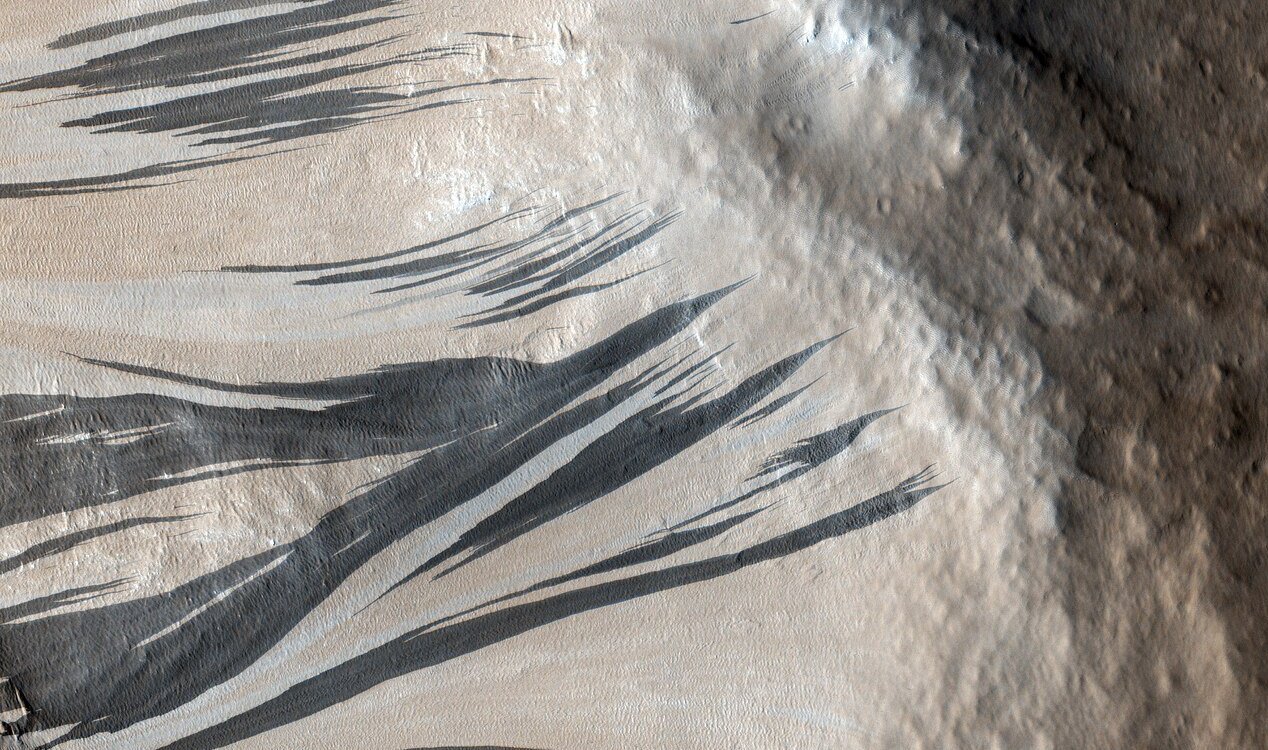
Image: Slope Streaks in Acheron Fossae on Mars
Credit: HiRISE, MRO, LPL (U. Arizona), NASA / (PD)
Now though, a new study has cast this discovery in to serious doubt by suggesting that the dark streaks observed on the planet's surface may actually be little more than sand dunes.
Known as Recurring Slope Lineae (RSL), these distinctive surface features have been described by researchers as 'inconsistent with models for water sources' and are instead 'identical to the slopes of sand dunes where movement is caused by dry granular flows'.
"Water almost certainly is not responsible for this behavior, which would require the volume of liquid to correspond to the length of slope available, producing more liquid on longer slopes," they wrote.
Source: Sky News
Mars liquid water discovery cast in to doubt
By T.K. RandallNovember 23, 2017
Image: Slope Streaks in Acheron Fossae on Mars
Credit: HiRISE, MRO, LPL (U. Arizona), NASA / (PD)
Dark streaks on the Martian surface thought to be evidence of water may actually be little more than sand.
Back in 2015, there was much excitement in the scientific community when NASA's director of planetary science, Jim Green, declared that evidence of liquid water had been found on Mars.Now though, a new study has cast this discovery in to serious doubt by suggesting that the dark streaks observed on the planet's surface may actually be little more than sand dunes.
"Water almost certainly is not responsible for this behavior, which would require the volume of liquid to correspond to the length of slope available, producing more liquid on longer slopes," they wrote.
Source: Sky News
Similar stories based on this topic:



The Unexplained Mysteries
Book of Weird News
AVAILABLE NOW
Take a walk on the weird side with this compilation of some of the weirdest stories ever to grace the pages of a newspaper.
Click here to learn more

Support us on Patreon
BONUS CONTENTFor less than the cost of a cup of coffee, you can gain access to a wide range of exclusive perks including our popular 'Lost Ghost Stories' series.
Click here to learn more

1 week
2 weeks
3 weeks
1 month


This week
This month
All time
| - | 1. | Pareidolia |
 |
2. | Loch Ness Monster |
|
3. | Ghost |
 |
4. | Electronic Voice Phenomenon |
|
5. | Yeti |
|
6. | Area 51 |
|
7. | Paranormal |
| - | 8. | Spirit Photography (Classic) |
|
9. | Orb |
| - | 10. | Storm Area 51 |


Top | Home | Forum
News | Columns | Encyclopedia


UM 11.3 Unexplained-Mysteries.com (c) 2001-2026
Terms | Privacy Policy | Cookies | Contact
News | Columns | Encyclopedia
UM 11.3 Unexplained-Mysteries.com (c) 2001-2026
Terms | Privacy Policy | Cookies | Contact