





Space & Astronomy
March 11, 2019


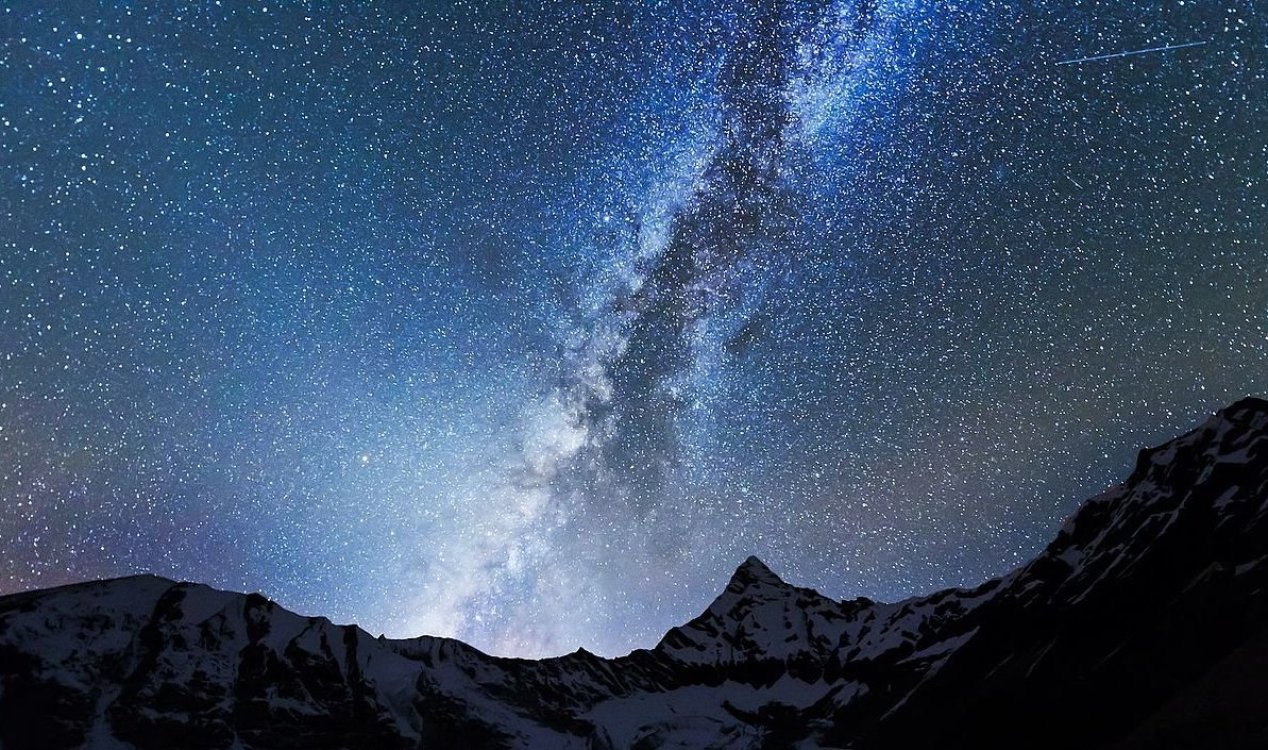
Image: Milky Way Galaxy Seen From Amphu Laptsa Base Camp
Credit: Pravin Mishra / CC BY-SA 4.0 (adapted)
What's particularly interesting is that only a small percentage of this mass is made up of the things that we actually know about such as stars, black holes, nebulae and other observable phenomena.
The rest is made up of 'dark energy', a highly mysterious form of invisible, undetectable matter that science is still struggling to get to grips with.
"Although we cannot see it, dark matter is the dominant form of matter in the universe, and it can be weighed through its influence on visible objects like the globular clusters," the Hubble team writes.
"The more massive a galaxy, the faster its globular clusters move under the pull of gravity. Most previous measurements have been along the line of sight to globular clusters, so astronomers know the speed at which a globular cluster is approaching or receding from Earth."
"However, Hubble and Gaia record the sideways motion of the globular clusters, from which a more reliable speed (and therefore gravitational acceleration) can be calculated."
Source: Hubblesite.org
How much does the Milky Way galaxy weigh ?
By T.K. RandallMarch 11, 2019
Image: Milky Way Galaxy Seen From Amphu Laptsa Base Camp
Credit: Pravin Mishra / CC BY-SA 4.0 (adapted)
Astronomers at NASA and ESA have come up with the most precise figure yet for the weight of our galaxy.
Using new data from NASA's Hubble Space Telescope and the European Space Agency's Gaia satellite, scientists have calculated that our galaxy has the equivalent mass of 1.5 trillion suns.What's particularly interesting is that only a small percentage of this mass is made up of the things that we actually know about such as stars, black holes, nebulae and other observable phenomena.
The rest is made up of 'dark energy', a highly mysterious form of invisible, undetectable matter that science is still struggling to get to grips with.
"The more massive a galaxy, the faster its globular clusters move under the pull of gravity. Most previous measurements have been along the line of sight to globular clusters, so astronomers know the speed at which a globular cluster is approaching or receding from Earth."
"However, Hubble and Gaia record the sideways motion of the globular clusters, from which a more reliable speed (and therefore gravitational acceleration) can be calculated."
Source: Hubblesite.org
Similar stories based on this topic:



The Unexplained Mysteries
Book of Weird News
AVAILABLE NOW
Take a walk on the weird side with this compilation of some of the weirdest stories ever to grace the pages of a newspaper.
Click here to learn more

Support us on Patreon
BONUS CONTENTFor less than the cost of a cup of coffee, you can gain access to a wide range of exclusive perks including our popular 'Lost Ghost Stories' series.
Click here to learn more

1 week
2 weeks
3 weeks
1 month


This week
This month
All time
 |
1. | Pareidolia |
 |
2. | Electronic Voice Phenomenon |
|
3. | Yeti |
|
4. | Paranormal |
|
5. | Orb |
|
6. | Loch Ness Monster |
|
7. | Area 51 |
|
8. | Spirit Photography (Classic) |
|
9. | Ghost |
|
10. | Storm Area 51 |


Top | Home | Forum
News | Columns | Encyclopedia


UM 11.3 Unexplained-Mysteries.com (c) 2001-2026
Terms | Privacy Policy | Cookies | Contact
News | Columns | Encyclopedia
UM 11.3 Unexplained-Mysteries.com (c) 2001-2026
Terms | Privacy Policy | Cookies | Contact