





Nature & Environment
July 3, 2022


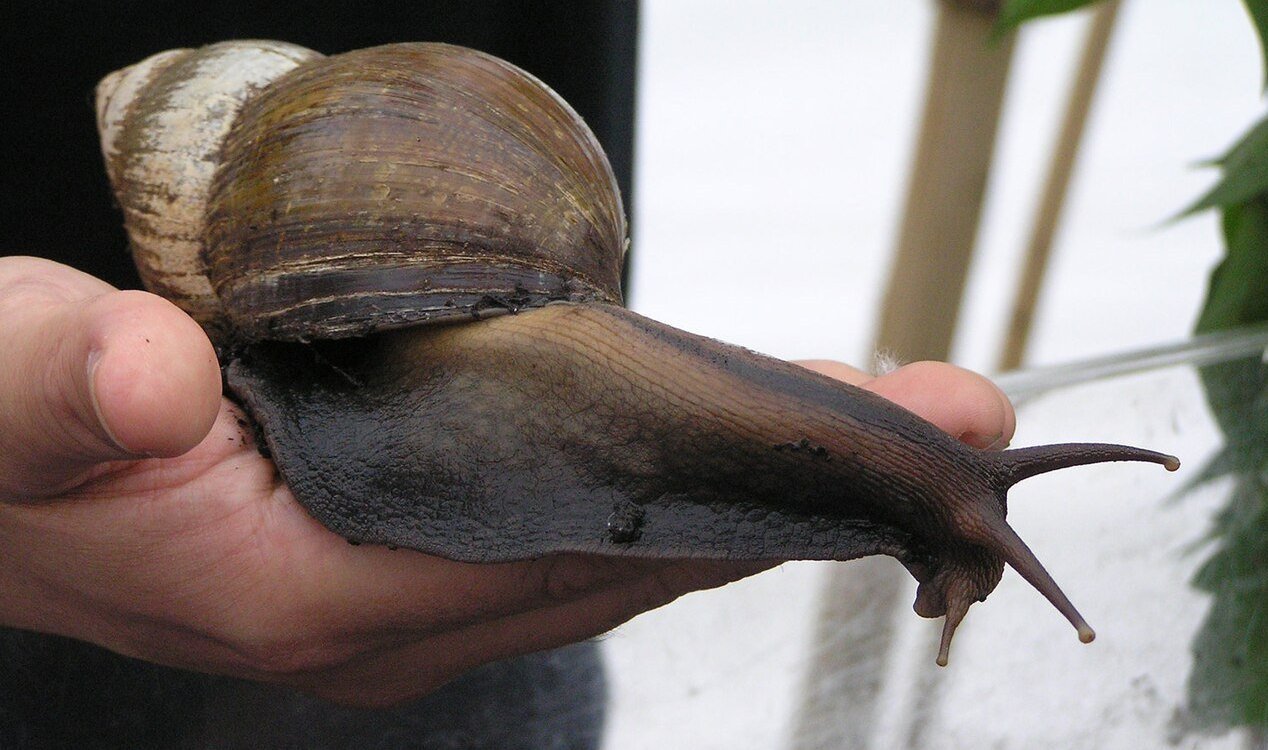
Image: Achatina - Giant African Snail
Credit: Grzegorz Polak / CC BY-SA 3.0 (adapted)
When an infestation of the creatures was recently confirmed in the Florida city of Port Richey, therefore, authorities moved quickly to establish a quarantine on its residents which forbids the movement of plants, soil, debris and building materials to or from certain zones.
The snails are known to reproduce quickly and have a penchant for eating various types of plants and even concrete - making them a menace to both the wildlife and the local infrastructure.
When they showed up in Southern Florida in the 1960s, it took ten years to get rid of them.
"Each snail contains both female and male reproductive organs," the United States Department of Agriculture said in a statement. "After a single mating, each snail can produce 100 to 500 eggs. "
"These snails can reproduce several more times without mating again. They can generate clutches of eggs every two to three months."
A lack of any natural predators in the area is also serving to exacerbate the problem.
Source: Mail Online
Giant snails put Florida town into quarantine
By T.K. RandallJuly 3, 2022
Image: Achatina - Giant African Snail
Credit: Grzegorz Polak / CC BY-SA 3.0 (adapted)
An invasive species of giant snail has resulted in restrictions being placed on the area.
Capable of growing up to eight inches in length, the Giant African land snail is a notorious invasive species that can actually prove dangerous to humans due to its tendency to carry a type of lungworm that can cause meningitis.When an infestation of the creatures was recently confirmed in the Florida city of Port Richey, therefore, authorities moved quickly to establish a quarantine on its residents which forbids the movement of plants, soil, debris and building materials to or from certain zones.
The snails are known to reproduce quickly and have a penchant for eating various types of plants and even concrete - making them a menace to both the wildlife and the local infrastructure.
"Each snail contains both female and male reproductive organs," the United States Department of Agriculture said in a statement. "After a single mating, each snail can produce 100 to 500 eggs. "
"These snails can reproduce several more times without mating again. They can generate clutches of eggs every two to three months."
A lack of any natural predators in the area is also serving to exacerbate the problem.
Source: Mail Online
Similar stories based on this topic:



The Unexplained Mysteries
Book of Weird News
AVAILABLE NOW
Take a walk on the weird side with this compilation of some of the weirdest stories ever to grace the pages of a newspaper.
Click here to learn more

Support us on Patreon
BONUS CONTENTFor less than the cost of a cup of coffee, you can gain access to a wide range of exclusive perks including our popular 'Lost Ghost Stories' series.
Click here to learn more

1 week
2 weeks
3 weeks
1 month


This week
This month
All time
| - | 1. | Pareidolia |
 |
2. | Loch Ness Monster |
|
3. | Ghost |
 |
4. | Yeti |
|
5. | Electronic Voice Phenomenon |
|
6. | Area 51 |
|
7. | Paranormal |
| - | 8. | Spirit Photography (Classic) |
|
9. | Orb |
| - | 10. | Storm Area 51 |


Top | Home | Forum
News | Columns | Encyclopedia


UM 11.3 Unexplained-Mysteries.com (c) 2001-2026
Terms | Privacy Policy | Cookies | Contact
News | Columns | Encyclopedia
UM 11.3 Unexplained-Mysteries.com (c) 2001-2026
Terms | Privacy Policy | Cookies | Contact