





World of the Bizarre
April 14, 2015


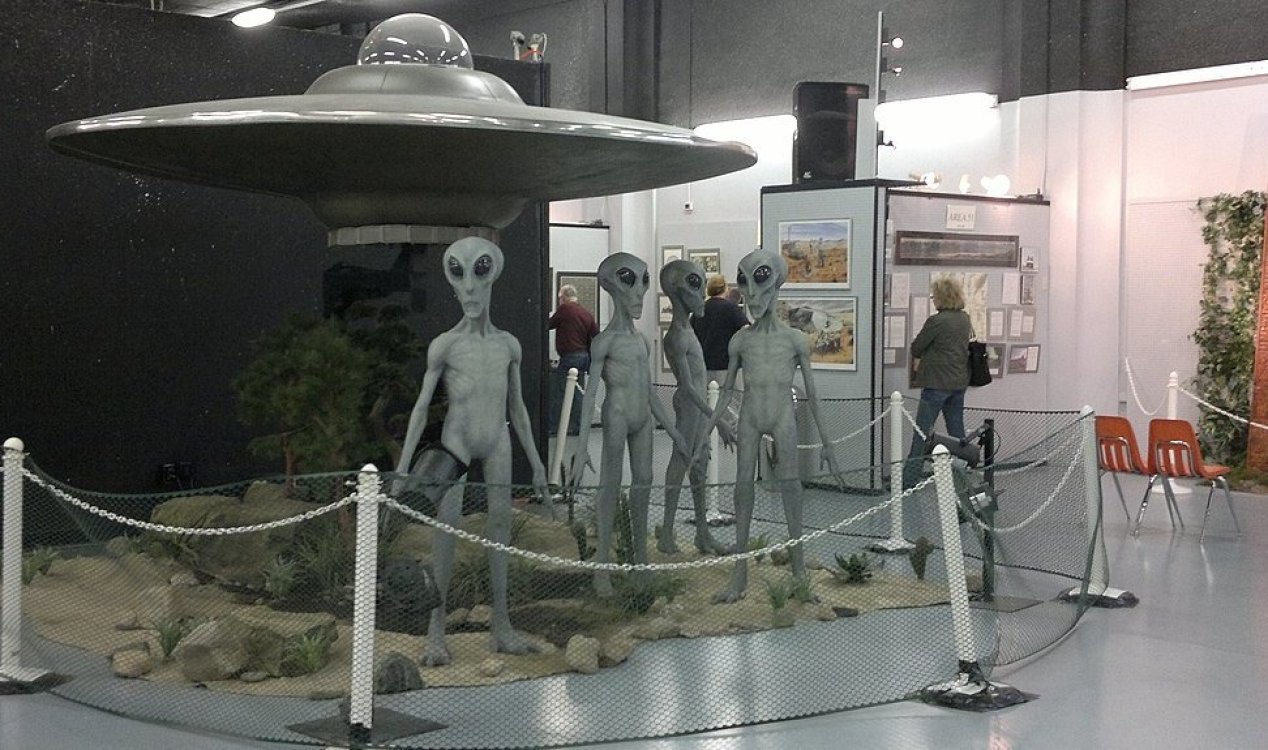
Image: Gray Aliens with Saucer at The UFO Museum, Roswell
Credit: Kimble Young / CC BY-SA 2.0 (adapted)
Far from being a message from aliens however the perytons turned out to have a far more mundane, though amusing, explanation.
"We have identified strong out-of-band emission at 2.3-2.5 GHz associated with several peryton events," wrote astronomer Emily Petroff in a paper detailing the findings.
"Subsequent tests revealed that a peryton can be generated at 1.4 GHz when a microwave oven door is opened prematurely and the telescope is at an appropriate relative angle."
In other words - the mysterious peryton signals were being produced whenever someone was opening their microwave door before the timer had finished counting down.
Source: CNET.com
'Alien' signal turns out to be microwave oven
By T.K. RandallApril 14, 2015
Image: Gray Aliens with Saucer at The UFO Museum, Roswell
Credit: Kimble Young / CC BY-SA 2.0 (adapted)
Astronomers in Australia discovered an unexpected source for a series of mysterious radio signals.
The team at the Parkes Observatory in New South Wales had been investigating unexplained radio signals known as a perytons which bear a close resemblance to the mysterious "fast radio bursts" recently put forward as possible evidence of a type of intelligent extraterrestrial communication.Far from being a message from aliens however the perytons turned out to have a far more mundane, though amusing, explanation.
"Subsequent tests revealed that a peryton can be generated at 1.4 GHz when a microwave oven door is opened prematurely and the telescope is at an appropriate relative angle."
In other words - the mysterious peryton signals were being produced whenever someone was opening their microwave door before the timer had finished counting down.
Source: CNET.com



The Unexplained Mysteries
Book of Weird News
AVAILABLE NOW
Take a walk on the weird side with this compilation of some of the weirdest stories ever to grace the pages of a newspaper.
Click here to learn more

Support us on Patreon
BONUS CONTENTFor less than the cost of a cup of coffee, you can gain access to a wide range of exclusive perks including our popular 'Lost Ghost Stories' series.
Click here to learn more

1 week
2 weeks
3 weeks
1 month


This week
This month
All time
 |
1. | Loch Ness Monster |
 |
2. | Electronic Voice Phenomenon |
|
3. | Bigfoot |
| - | 4. | Area 51 |
|
5. | Pareidolia |
|
6. | Phoenix Lights |
|
7. | Orb |
|
8. | Ghost |
|
9. | Stanton Friedman |
|
10. | Spirit Photography (Classic) |


Top | Home | Forum
News | Columns | Encyclopedia


UM 11.3 Unexplained-Mysteries.com (c) 2001-2026
Terms | Privacy Policy | Cookies | Contact
News | Columns | Encyclopedia
UM 11.3 Unexplained-Mysteries.com (c) 2001-2026
Terms | Privacy Policy | Cookies | Contact