





Space & Astronomy
June 25, 2015


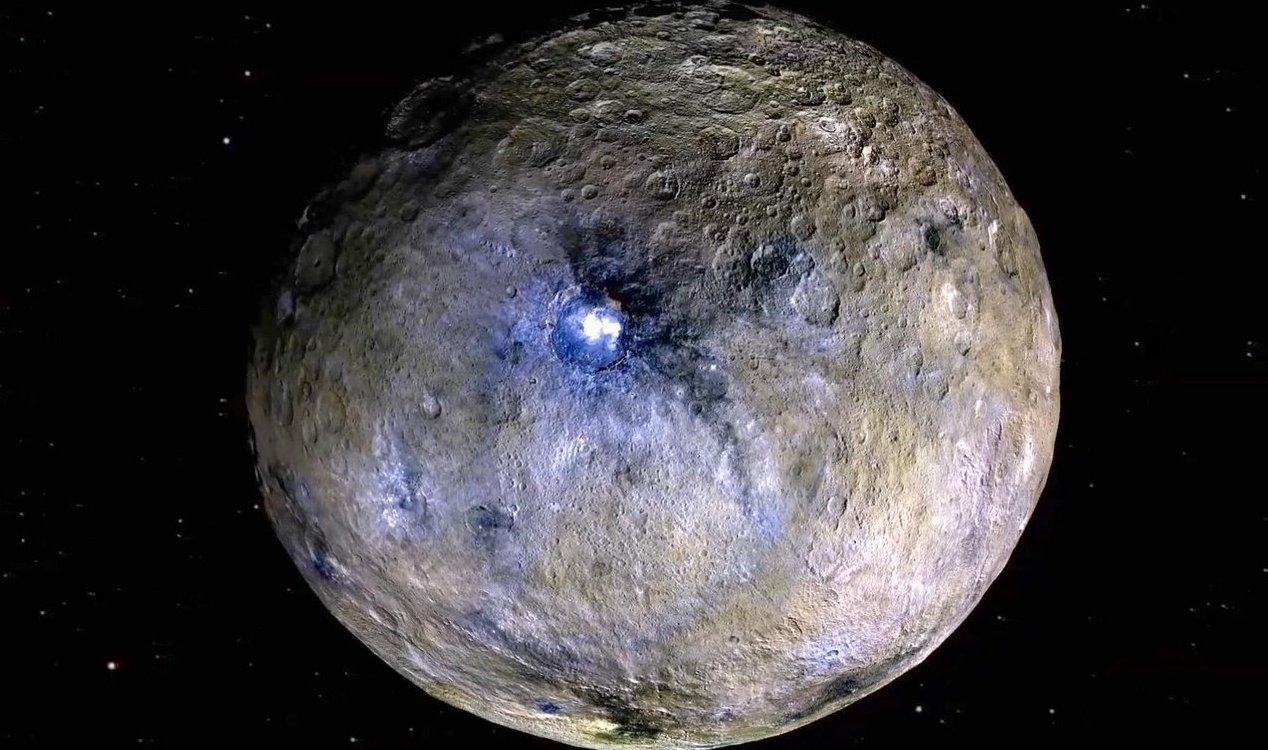
Image: Rendering of the Dwarf Planet Ceres
Credit: NASA/JPL-Caltech/UCLA/MPS/DLR/IDA / (PD)
Chief among its more unusual features are its bright spots which, having mystified experts during the approach of the Dawn spacecraft earlier this year, are now believed to be the result of surface ice glistening in the sunlight.
The latest images taken of the dwarf planet have also revealed what looks like a pyramid-shaped mountain that stands out like a sore thumb against its otherwise predominantly flat landscape.
Measuring approximately one mile in height it isn't clear what the object is or how it got there.
"The surface of Ceres has revealed many interesting and unique features," said mission deputy principle investigator Carol Raymond.
"For example, icy moons in the outer solar system have craters with central pits, but on Ceres central pits in large craters are much more common. These and other features will allow us to understand the inner structure of Ceres that we cannot sense directly."
Source: First Post
'Pyramid-shaped' mountain found on Ceres
By T.K. RandallJune 25, 2015
Image: Rendering of the Dwarf Planet Ceres
Credit: NASA/JPL-Caltech/UCLA/MPS/DLR/IDA / (PD)
NASA's Dawn spacecraft has identified an anomalous structure on the surface of the dwarf planet.
The largest object in the asteroid belt between Mars and Jupiter, Ceres has been no stranger to mystery and intrigue since photographs of it were first posted online.Chief among its more unusual features are its bright spots which, having mystified experts during the approach of the Dawn spacecraft earlier this year, are now believed to be the result of surface ice glistening in the sunlight.
The latest images taken of the dwarf planet have also revealed what looks like a pyramid-shaped mountain that stands out like a sore thumb against its otherwise predominantly flat landscape.
"The surface of Ceres has revealed many interesting and unique features," said mission deputy principle investigator Carol Raymond.
"For example, icy moons in the outer solar system have craters with central pits, but on Ceres central pits in large craters are much more common. These and other features will allow us to understand the inner structure of Ceres that we cannot sense directly."
Source: First Post
Similar stories based on this topic:



The Unexplained Mysteries
Book of Weird News
AVAILABLE NOW
Take a walk on the weird side with this compilation of some of the weirdest stories ever to grace the pages of a newspaper.
Click here to learn more

Support us on Patreon
BONUS CONTENTFor less than the cost of a cup of coffee, you can gain access to a wide range of exclusive perks including our popular 'Lost Ghost Stories' series.
Click here to learn more

1 week
2 weeks
3 weeks
1 month


This week
This month
All time
 |
1. | Electronic Voice Phenomenon |
|
2. | Pareidolia |
|
3. | Orb |
|
4. | Area 51 |
|
5. | Spirit Photography (Classic) |
 |
6. | Loch Ness Monster |
| - | 7. | Yeti |
|
8. | Ghost |
| - | 9. | Bigfoot |
|
10. | Storm Area 51 |


Top | Home | Forum
News | Columns | Encyclopedia


UM 11.3 Unexplained-Mysteries.com (c) 2001-2026
Terms | Privacy Policy | Cookies | Contact
News | Columns | Encyclopedia
UM 11.3 Unexplained-Mysteries.com (c) 2001-2026
Terms | Privacy Policy | Cookies | Contact