





Palaeontology
June 8, 2017


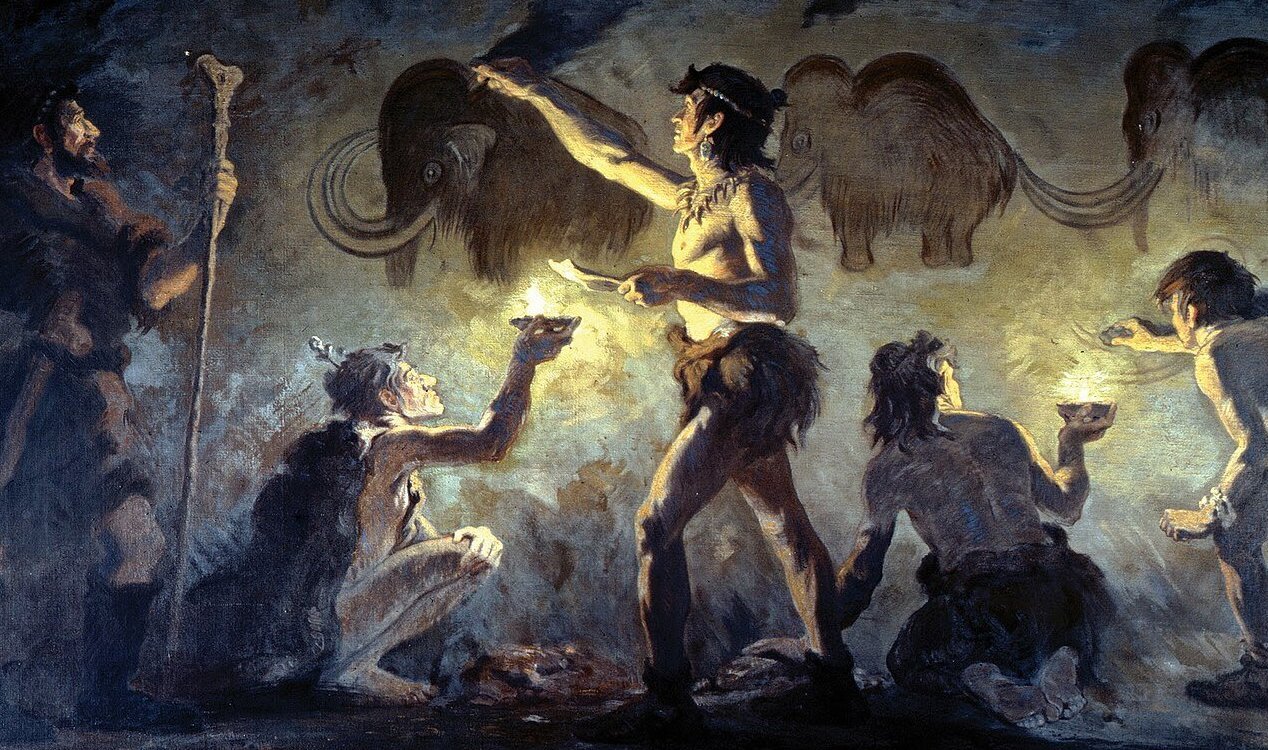
Image: Cro-Magnon Artists Painting Woolly Mammoths in Font-de-Gaume
Credit: Charles Robert Knight (1920) / (PD) Copyright Expired
The discovery has the potential to rewrite the book on the emergence of Homo sapiens.
"It is not the story of it happening in a rapid way in a 'Garden of Eden' somewhere in Africa," said Prof Jean-Jacques Hublin, of the Max Planck Institute for Evolutionary Anthropology.
"Our view is that it was a more gradual development and it involved the whole continent. So if there was a Garden of Eden, it was all of Africa."
The fossils, which include skulls, teeth and bones, were found at Jebel Irhoud in Morocco. Earlier such finds from the site were originally dated to around 40,000 years ago, but now, thanks to modern techniques, these latest remains have been found to be up to 350,000 years old.
"We now have to modify the vision of how the first modern humans emerged," said Prof Hublin.
Source: BBC News
Earliest Homo sapiens unearthed in Morocco
By T.K. RandallJune 8, 2017
Image: Cro-Magnon Artists Painting Woolly Mammoths in Font-de-Gaume
Credit: Charles Robert Knight (1920) / (PD) Copyright Expired
The discovery casts doubt on the idea that modern humans evolved in a single 'cradle of humanity'.
The fossils suggest that our species not only emerged 100,000 years earlier than previously thought but that we evolved across the whole continent as oppose to within a single small region of it.The discovery has the potential to rewrite the book on the emergence of Homo sapiens.
"It is not the story of it happening in a rapid way in a 'Garden of Eden' somewhere in Africa," said Prof Jean-Jacques Hublin, of the Max Planck Institute for Evolutionary Anthropology.
The fossils, which include skulls, teeth and bones, were found at Jebel Irhoud in Morocco. Earlier such finds from the site were originally dated to around 40,000 years ago, but now, thanks to modern techniques, these latest remains have been found to be up to 350,000 years old.
"We now have to modify the vision of how the first modern humans emerged," said Prof Hublin.
Source: BBC News
Similar stories based on this topic:



The Unexplained Mysteries
Book of Weird News
AVAILABLE NOW
Take a walk on the weird side with this compilation of some of the weirdest stories ever to grace the pages of a newspaper.
Click here to learn more

Support us on Patreon
BONUS CONTENTFor less than the cost of a cup of coffee, you can gain access to a wide range of exclusive perks including our popular 'Lost Ghost Stories' series.
Click here to learn more

1 week
2 weeks
3 weeks
1 month


This week
This month
All time
| - | 1. | Pareidolia |
 |
2. | Loch Ness Monster |
|
3. | Ghost |
 |
4. | Electronic Voice Phenomenon |
|
5. | Yeti |
|
6. | Area 51 |
|
7. | Paranormal |
| - | 8. | Spirit Photography (Classic) |
|
9. | Orb |
| - | 10. | Storm Area 51 |


Top | Home | Forum
News | Columns | Encyclopedia


UM 11.3 Unexplained-Mysteries.com (c) 2001-2026
Terms | Privacy Policy | Cookies | Contact
News | Columns | Encyclopedia
UM 11.3 Unexplained-Mysteries.com (c) 2001-2026
Terms | Privacy Policy | Cookies | Contact