





Space & Astronomy
February 8, 2018


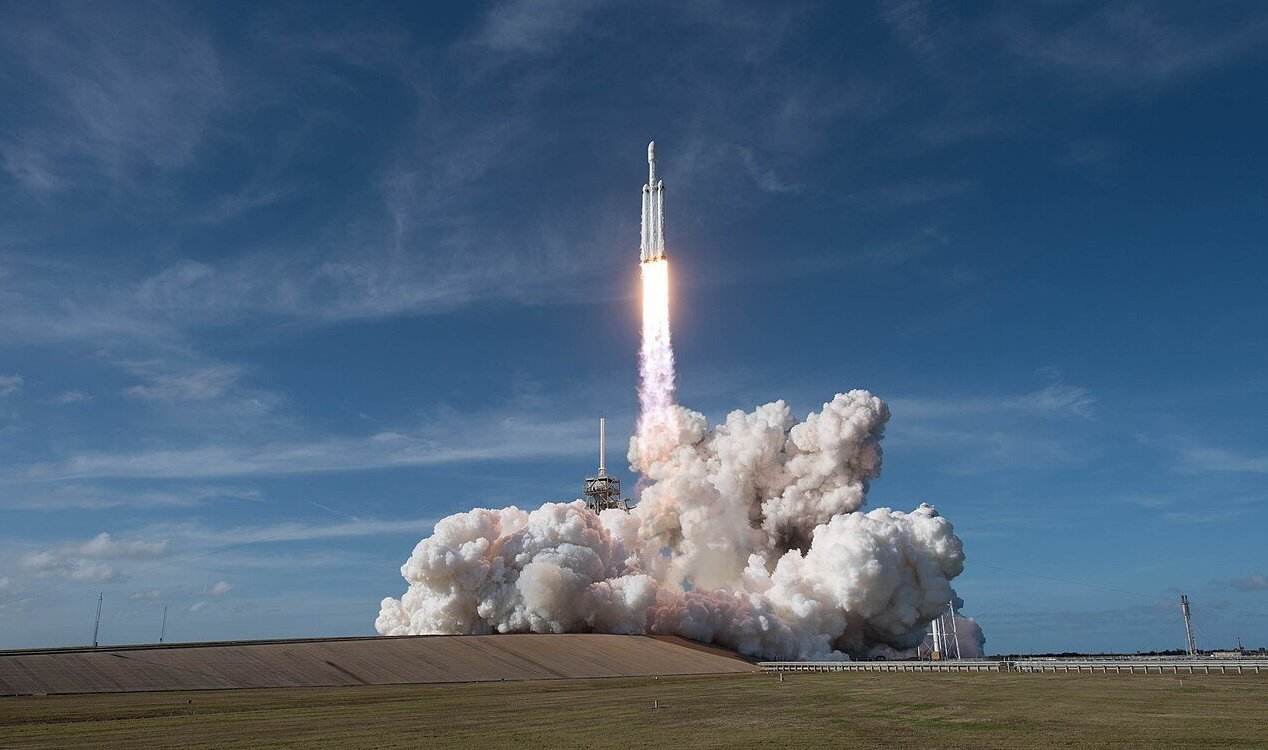
Image: SpaceX Falcon Heavy Rocket Launch (2018)
Credit: Daniel Oberhaus / CC BY 4.0 (adapted)
The destination of its unusual payload was to be a heliocentric orbit roughly the same distance from the Sun as Mars, but now it seems as though the Falcon Heavy's boosters burned a little too long, pushing the car in to a wider orbit that will instead take it through the asteroid belt.
While the $100,000 Tesla is likely to remain in one piece for the foreseeable future, once it reaches the belt there will be a much greater risk of a collision.
Eventually, the radiation of space will also take its toll.
"All of the organics will be subjected to degradation by the various types of radiation that you will run into there," said William Carroll, professor of chemistry at Indiana University.
"As the bonds break, the car can literally fall apart."
Source: The Guardian
Historic SpaceX launch overshoots Mars
By T.K. RandallFebruary 8, 2018
Image: SpaceX Falcon Heavy Rocket Launch (2018)
Credit: Daniel Oberhaus / CC BY 4.0 (adapted)
Elon Musk's Tesla Roadster is set to venture even further away from home than anyone had expected.
The air was filled with cheers on Tuesday as the world's most powerful rocket - the Falcon Heavy - soared in to the sky above Cape Canaveral for the first time.The destination of its unusual payload was to be a heliocentric orbit roughly the same distance from the Sun as Mars, but now it seems as though the Falcon Heavy's boosters burned a little too long, pushing the car in to a wider orbit that will instead take it through the asteroid belt.
Third burn successful. Exceeded Mars orbit and kept going to the Asteroid Belt. pic.twitter.com/bKhRN73WHF
— Elon Musk (@elonmusk) February 7, 2018
While the $100,000 Tesla is likely to remain in one piece for the foreseeable future, once it reaches the belt there will be a much greater risk of a collision.
"All of the organics will be subjected to degradation by the various types of radiation that you will run into there," said William Carroll, professor of chemistry at Indiana University.
"As the bonds break, the car can literally fall apart."
Source: The Guardian
Similar stories based on this topic:



The Unexplained Mysteries
Book of Weird News
AVAILABLE NOW
Take a walk on the weird side with this compilation of some of the weirdest stories ever to grace the pages of a newspaper.
Click here to learn more

Support us on Patreon
BONUS CONTENTFor less than the cost of a cup of coffee, you can gain access to a wide range of exclusive perks including our popular 'Lost Ghost Stories' series.
Click here to learn more

1 week
2 weeks
3 weeks
1 month


This week
This month
All time
 |
1. | Loch Ness Monster |
|
2. | Electronic Voice Phenomenon |
 |
3. | Pareidolia |
|
4. | Ghost |
|
5. | Orb |
|
6. | Area 51 |
|
7. | Yeti |
|
8. | Spirit Photography (Classic) |
|
9. | Bigfoot |
|
10. | Extraterrestrial |


Top | Home | Forum
News | Columns | Encyclopedia


UM 11.3 Unexplained-Mysteries.com (c) 2001-2026
Terms | Privacy Policy | Cookies | Contact
News | Columns | Encyclopedia
UM 11.3 Unexplained-Mysteries.com (c) 2001-2026
Terms | Privacy Policy | Cookies | Contact