





Spirituality
November 1, 2024


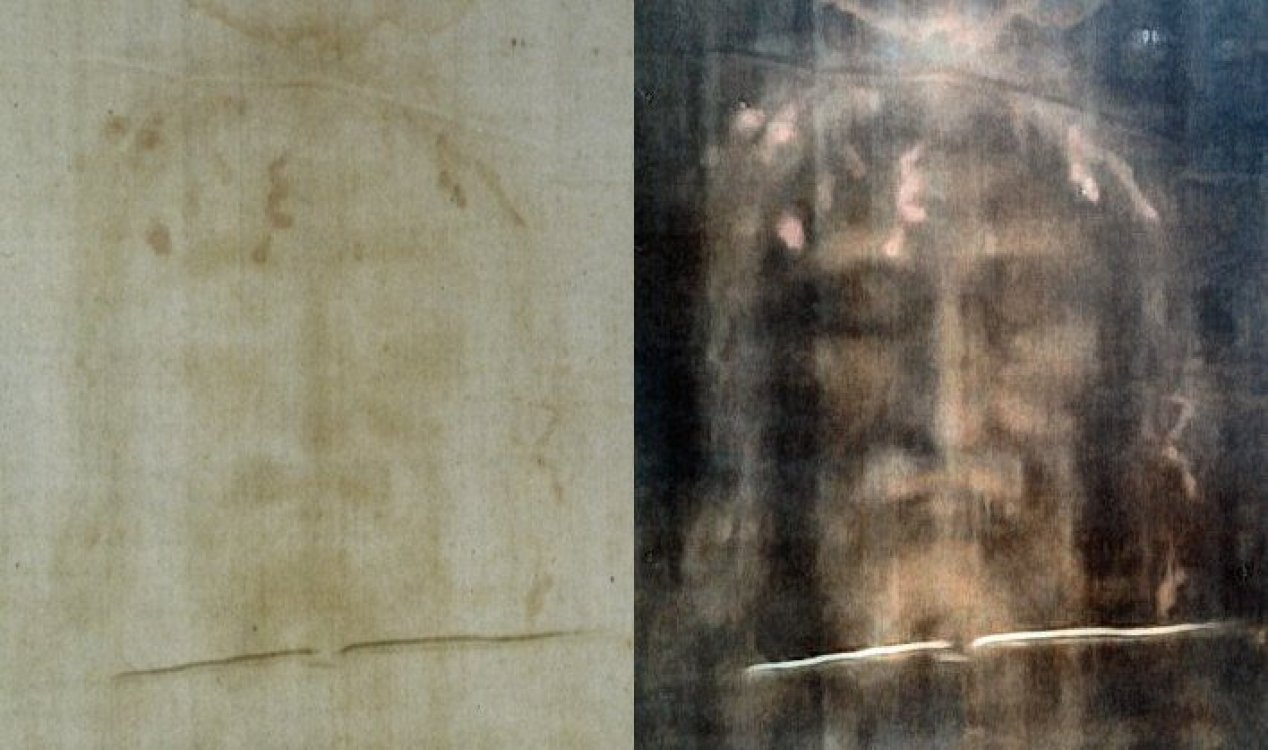
Image: Turin Shroud
Credit: CC BY-SA 3.0 / Dianelos Georgoudis
A significant number of researchers have made conflicting claims about the shroud, with some hailing it as authentic and others suggesting that it is either a forgery or not the shroud of Jesus at all.
The findings of this latest study fall firmly into the latter category.
Cicero Moraes - a graphics expert from Brazil - wanted to find out if it was possible for an imprint like that shown on the shroud to actually be created by placing a cloth over a dead body.
To determine this, he created a virtual computer simulation to see if the imprint matched the impressions that an actual human body would make when touching the cloth.
His findings suggested that it was highly unlikely that the shroud featured a genuine image of Jesus.
"When you wrap a 3D object with a fabric, and that object leaves a pattern like blood stains, these stains generate a more robust and more deformed structure in relation to the source," he said.
"So, roughly speaking, what we see as a result of printing stains from a human body would be a more swollen and distorted version of it, not an image that looks like a photocopy. A bas-relief, however, wouldn't cause the image to deform, resulting in a figure that resembles a photocopy of the body."
Moraes was, however, able to offer up his own explanation for the nature and origins of the shroud.
"On one side are those who think it is an authentic shroud of Jesus Christ, on the other, those who think it is a forgery," he said.
"But I am inclined towards another approach: that it is, in fact, a work of Christian art, which managed to convey its intended message very successfully."
Source: WIO News
Was the Shroud of Turin really used to wrap the body of Jesus ?
By T.K. RandallNovember 1, 2024
Image: Turin Shroud
Credit: CC BY-SA 3.0 / Dianelos Georgoudis
A virtual simulation has been used in an effort to determine if the famous biblical relic really shows the image of Jesus.
Believed by many to be the actual burial cloth of Jesus himself, the Turin Shroud - which is today situated in the Cathedral of St. John the Baptist in Turin, Italy - has long been the subject of intense scrutiny, controversy and debate.A significant number of researchers have made conflicting claims about the shroud, with some hailing it as authentic and others suggesting that it is either a forgery or not the shroud of Jesus at all.
The findings of this latest study fall firmly into the latter category.
Cicero Moraes - a graphics expert from Brazil - wanted to find out if it was possible for an imprint like that shown on the shroud to actually be created by placing a cloth over a dead body.
To determine this, he created a virtual computer simulation to see if the imprint matched the impressions that an actual human body would make when touching the cloth.
"When you wrap a 3D object with a fabric, and that object leaves a pattern like blood stains, these stains generate a more robust and more deformed structure in relation to the source," he said.
"So, roughly speaking, what we see as a result of printing stains from a human body would be a more swollen and distorted version of it, not an image that looks like a photocopy. A bas-relief, however, wouldn't cause the image to deform, resulting in a figure that resembles a photocopy of the body."
Moraes was, however, able to offer up his own explanation for the nature and origins of the shroud.
"On one side are those who think it is an authentic shroud of Jesus Christ, on the other, those who think it is a forgery," he said.
"But I am inclined towards another approach: that it is, in fact, a work of Christian art, which managed to convey its intended message very successfully."
Source: WIO News
Similar stories based on this topic:



The Unexplained Mysteries
Book of Weird News
AVAILABLE NOW
Take a walk on the weird side with this compilation of some of the weirdest stories ever to grace the pages of a newspaper.
Click here to learn more

Support us on Patreon
BONUS CONTENTFor less than the cost of a cup of coffee, you can gain access to a wide range of exclusive perks including our popular 'Lost Ghost Stories' series.
Click here to learn more

1 week
2 weeks
3 weeks
1 month


This week
This month
All time
 |
1. | Loch Ness Monster |
|
2. | Electronic Voice Phenomenon |
 |
3. | Pareidolia |
|
4. | Ghost |
|
5. | Orb |
|
6. | Area 51 |
|
7. | Yeti |
|
8. | Spirit Photography (Classic) |
|
9. | Bigfoot |
|
10. | Extraterrestrial |


Top | Home | Forum
News | Columns | Encyclopedia


UM 11.3 Unexplained-Mysteries.com (c) 2001-2026
Terms | Privacy Policy | Cookies | Contact
News | Columns | Encyclopedia
UM 11.3 Unexplained-Mysteries.com (c) 2001-2026
Terms | Privacy Policy | Cookies | Contact