





Space & Astronomy
May 5, 2018


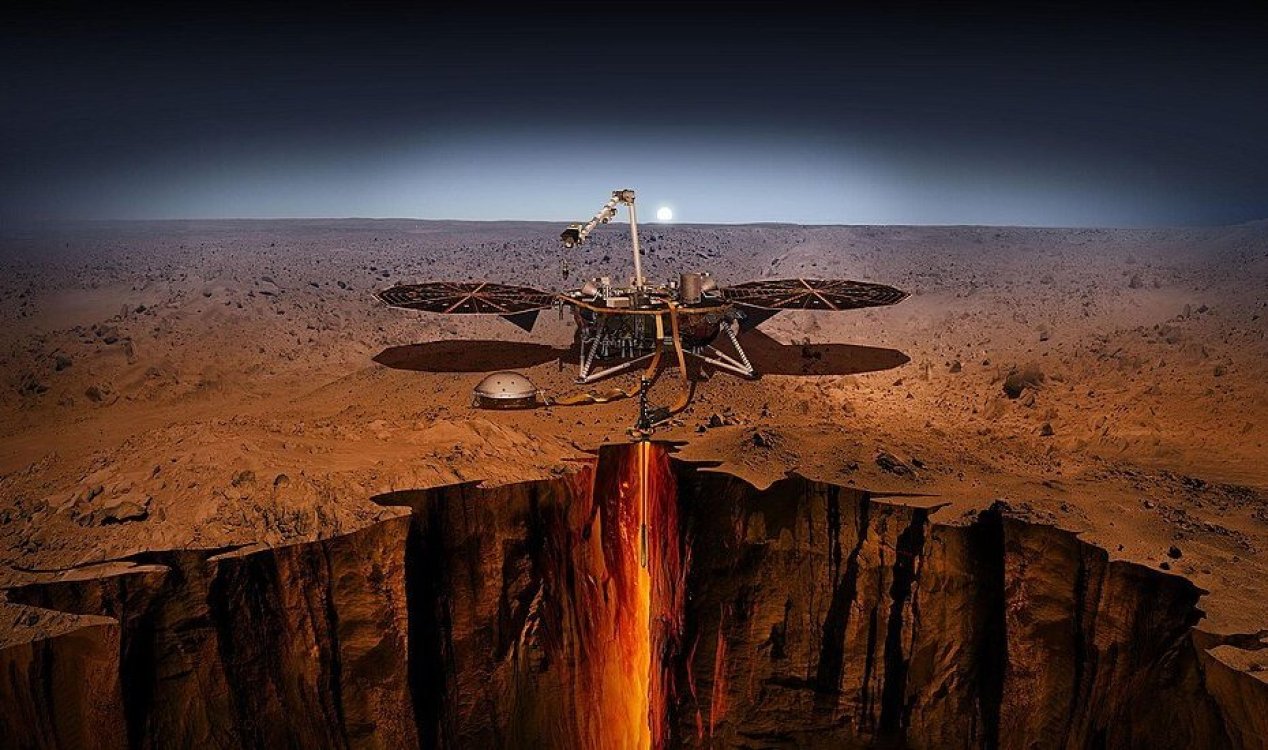
Image: Artist's Illustration of NASA's InSight Lander on Mars.
Credit: (PD) NASA/JPL-Caltech
A radio science experiment will also be carried out to study the planet's internal structure.
"This mission will probe the interior of another terrestrial planet, giving us an idea of the size of the core, the mantle, the crust and our ability then to compare that with the Earth," said NASA chief scientist Jim Green.
"This is of fundamental importance to understand the origin of our solar system and how it became the way it is today."
The mission, which is expected to last two Earth years, will ultimately produce a true 3D image of Mars, offering clues as to how the planet (and by extension the Earth) formed billions of years ago.
"InSight, for seismologists, will really be a piece of history," said scientist Philippe Lognonne.
Source: The Guardian
NASA's InSight lander is on its way to Mars
By T.K. RandallMay 5, 2018
Image: Artist's Illustration of NASA's InSight Lander on Mars.
Credit: (PD) NASA/JPL-Caltech
The spacecraft blasted off from Vandenberg Air Force Base in California aboard an Atlas V rocket earlier today.
Expected to land on Mars in November of this year, the $1 billion lander will attempt to learn more about what lies beneath the surface of the Red Planet using an array of instruments including a burrowing temperature sensor and a seismometer designed to detect Marsquakes. A radio science experiment will also be carried out to study the planet's internal structure.
"This mission will probe the interior of another terrestrial planet, giving us an idea of the size of the core, the mantle, the crust and our ability then to compare that with the Earth," said NASA chief scientist Jim Green.
The mission, which is expected to last two Earth years, will ultimately produce a true 3D image of Mars, offering clues as to how the planet (and by extension the Earth) formed billions of years ago.
"InSight, for seismologists, will really be a piece of history," said scientist Philippe Lognonne.
Source: The Guardian
Similar stories based on this topic:



The Unexplained Mysteries
Book of Weird News
AVAILABLE NOW
Take a walk on the weird side with this compilation of some of the weirdest stories ever to grace the pages of a newspaper.
Click here to learn more

Support us on Patreon
BONUS CONTENTFor less than the cost of a cup of coffee, you can gain access to a wide range of exclusive perks including our popular 'Lost Ghost Stories' series.
Click here to learn more

1 week
2 weeks
3 weeks
1 month


This week
This month
All time
| - | 1. | Pareidolia |
 |
2. | Loch Ness Monster |
|
3. | Ghost |
 |
4. | Electronic Voice Phenomenon |
|
5. | Yeti |
|
6. | Area 51 |
|
7. | Paranormal |
| - | 8. | Spirit Photography (Classic) |
|
9. | Orb |
| - | 10. | Storm Area 51 |


Top | Home | Forum
News | Columns | Encyclopedia


UM 11.3 Unexplained-Mysteries.com (c) 2001-2026
Terms | Privacy Policy | Cookies | Contact
News | Columns | Encyclopedia
UM 11.3 Unexplained-Mysteries.com (c) 2001-2026
Terms | Privacy Policy | Cookies | Contact