





Space & Astronomy
November 7, 2018


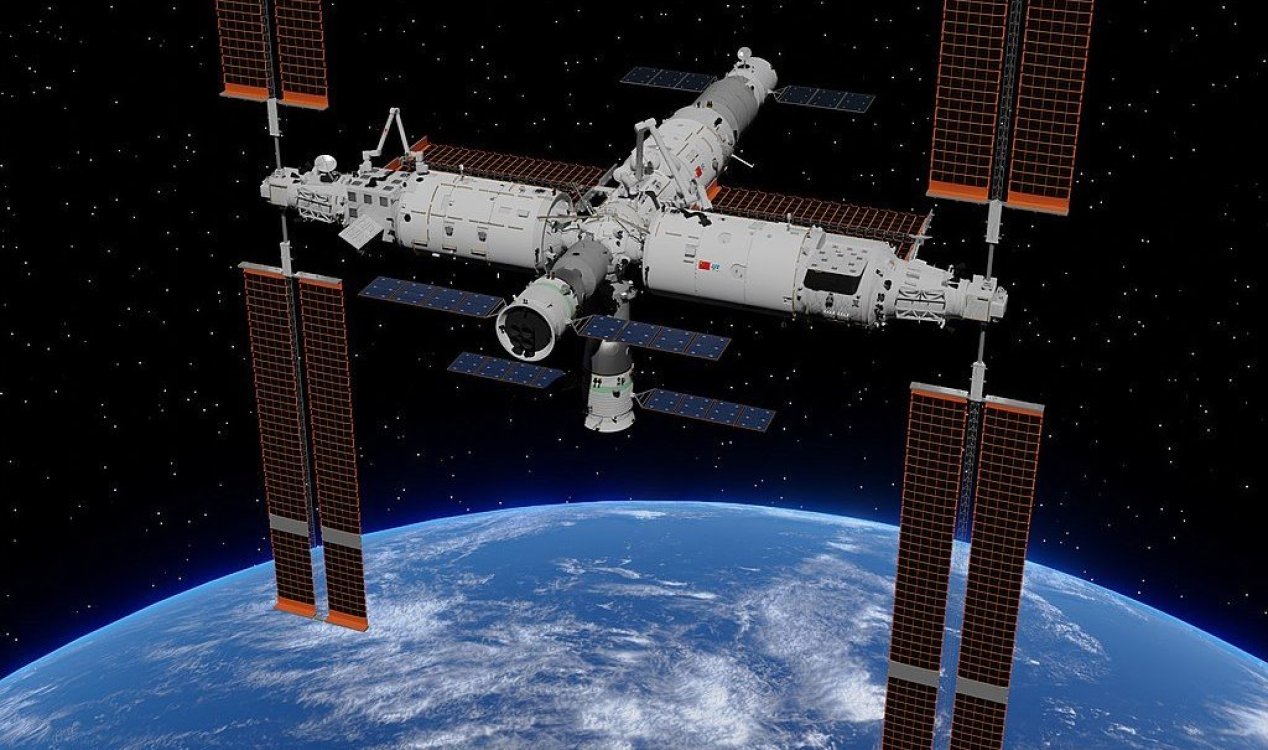
Image: Chinese Tiangong Space Station
Credit: Shujianyang / CC BY-SA 4.0 (adapted)
While significantly smaller than the International Space Station, the new platform will be able to support a crew of three and will open its doors to scientific experiments from other UN countries.
ESA has already sent astronauts to China to receive training for possible future manned missions.
A full-scale replica of the new station's 55ft central module was unveiled this week at the 12th China International Aviation and Aerospace Exhibition in Zhuhai city.
"I'm sure over time China will be successful developing partnerships," said space analyst Bill Ostrove.
"Many countries, and increasingly private companies and universities, have space programs, but cannot afford to build their own space station."
"The ability to put payloads and experiments on a human spaceflight platform is extremely valuable."
Source: News.com.au
China unveils its plans for new space station
By T.K. RandallNovember 7, 2018
Image: Chinese Tiangong Space Station
Credit: Shujianyang / CC BY-SA 4.0 (adapted)
The new orbital platform will be China's first permanently manned space station when it launches in 2022.
Part of the Tiangong or 'Heavenly Palace' program, the station will be more ambitious than China's previous two orbital laboratories and will be the third ever modular station after Mir and the ISS.While significantly smaller than the International Space Station, the new platform will be able to support a crew of three and will open its doors to scientific experiments from other UN countries.
ESA has already sent astronauts to China to receive training for possible future manned missions.
A full-scale replica of the new station's 55ft central module was unveiled this week at the 12th China International Aviation and Aerospace Exhibition in Zhuhai city.
"Many countries, and increasingly private companies and universities, have space programs, but cannot afford to build their own space station."
"The ability to put payloads and experiments on a human spaceflight platform is extremely valuable."
VIDEO: Three astronauts will be permanently stationed in the Tiangong -- or "Heavenly Palace" -- orbiting lab pic.twitter.com/5TZcegWap3
— AFP news agency (@AFP) November 7, 2018
Source: News.com.au
Similar stories based on this topic:



The Unexplained Mysteries
Book of Weird News
AVAILABLE NOW
Take a walk on the weird side with this compilation of some of the weirdest stories ever to grace the pages of a newspaper.
Click here to learn more

Support us on Patreon
BONUS CONTENTFor less than the cost of a cup of coffee, you can gain access to a wide range of exclusive perks including our popular 'Lost Ghost Stories' series.
Click here to learn more

1 week
2 weeks
3 weeks
1 month


This week
This month
All time
| - | 1. | Pareidolia |
 |
2. | Loch Ness Monster |
|
3. | Ghost |
 |
4. | Electronic Voice Phenomenon |
|
5. | Yeti |
|
6. | Area 51 |
|
7. | Paranormal |
| - | 8. | Spirit Photography (Classic) |
|
9. | Orb |
| - | 10. | Storm Area 51 |


Top | Home | Forum
News | Columns | Encyclopedia


UM 11.3 Unexplained-Mysteries.com (c) 2001-2026
Terms | Privacy Policy | Cookies | Contact
News | Columns | Encyclopedia
UM 11.3 Unexplained-Mysteries.com (c) 2001-2026
Terms | Privacy Policy | Cookies | Contact