





Space & Astronomy
May 13, 2015


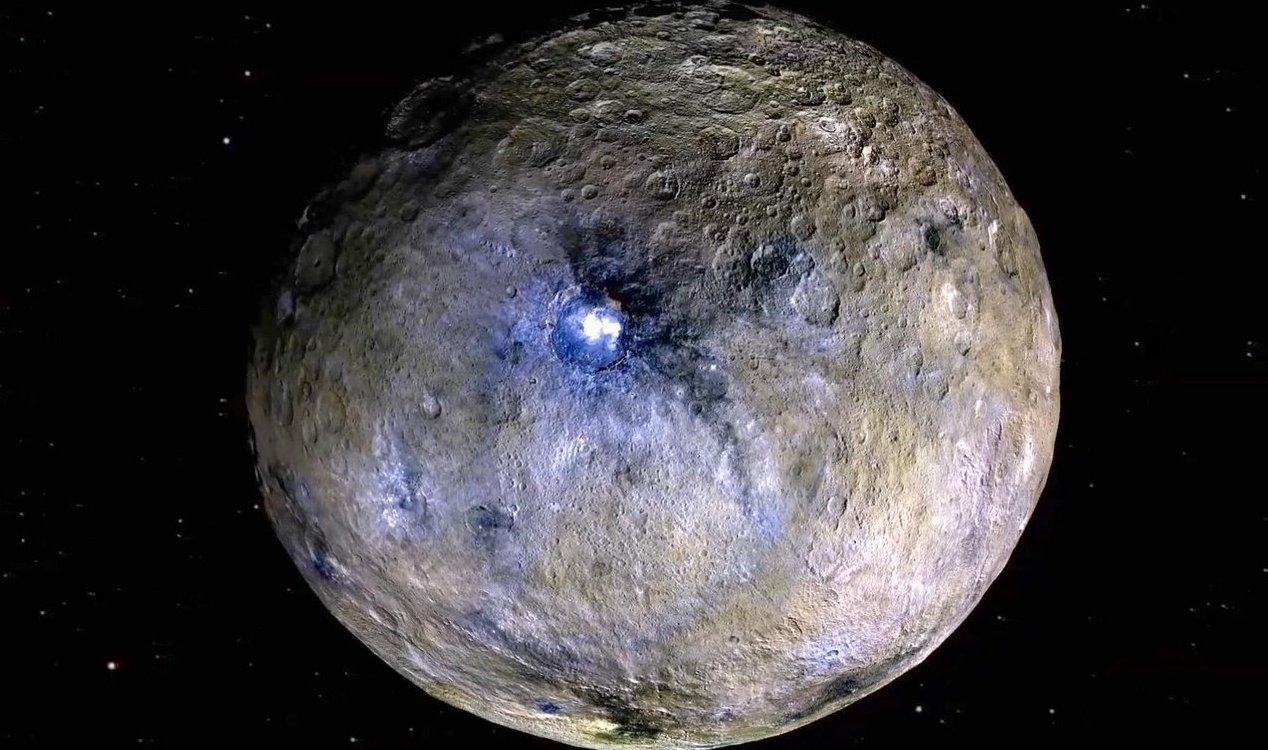
Image: Rendering of the Dwarf Planet Ceres
Credit: NASA/JPL-Caltech/UCLA/MPS/DLR/IDA / (PD)
Now at last NASA has been able to determine that these peculiar features are actually the result of sunlight reflecting off of something highly reflective on the planet's surface.
New images taken of Ceres have revealed that the two most prominent bright spots are actually made up of several smaller ones and that the whole surface appears to be littered with them.
"Dawn scientists can now conclude that the intense brightness of these spots is due to the reflection of sunlight by highly reflective material on the surface, possibly ice," said Christopher Russell, principal investigator for the Dawn mission.
While there is still a lot of work to do to confirm that the reflective material is indeed ice, NASA scientists are hoping that Dawn will provide the information they need over the coming months.
Source: Washington Post
NASA solves mystery of bright spots on Ceres
By T.K. RandallMay 13, 2015
Image: Rendering of the Dwarf Planet Ceres
Credit: NASA/JPL-Caltech/UCLA/MPS/DLR/IDA / (PD)
New photographs have provided important new clues to help solve the riddle of the mystery bright spots.
As NASA's Dawn spacecraft approached the enigmatic dwarf planet Ceres, the largest object in the asteroid belt between Mars and Jupiter, one of the first things that caught people's attention was a mysterious bright spot inside a crater on its surface.Now at last NASA has been able to determine that these peculiar features are actually the result of sunlight reflecting off of something highly reflective on the planet's surface.
New images taken of Ceres have revealed that the two most prominent bright spots are actually made up of several smaller ones and that the whole surface appears to be littered with them.
"Dawn scientists can now conclude that the intense brightness of these spots is due to the reflection of sunlight by highly reflective material on the surface, possibly ice," said Christopher Russell, principal investigator for the Dawn mission.
While there is still a lot of work to do to confirm that the reflective material is indeed ice, NASA scientists are hoping that Dawn will provide the information they need over the coming months.
Source: Washington Post
Similar stories based on this topic:



The Unexplained Mysteries
Book of Weird News
AVAILABLE NOW
Take a walk on the weird side with this compilation of some of the weirdest stories ever to grace the pages of a newspaper.
Click here to learn more

Support us on Patreon
BONUS CONTENTFor less than the cost of a cup of coffee, you can gain access to a wide range of exclusive perks including our popular 'Lost Ghost Stories' series.
Click here to learn more

1 week
2 weeks
3 weeks
1 month


This week
This month
All time
| - | 1. | Electronic Voice Phenomenon |
 |
2. | Spirit Photography (Classic) |
| - | 3. | Pareidolia |
|
4. | Roswell Incident |
|
5. | Yeti |
|
6. | Area 51 |
 |
7. | Orb |
|
8. | Loch Ness Monster |
|
9. | Paranormal |
|
10. | Bigfoot |


Top | Home | Forum
News | Columns | Encyclopedia


UM 11.3 Unexplained-Mysteries.com (c) 2001-2026
Terms | Privacy Policy | Cookies | Contact
News | Columns | Encyclopedia
UM 11.3 Unexplained-Mysteries.com (c) 2001-2026
Terms | Privacy Policy | Cookies | Contact