





Space & Astronomy
August 3, 2015


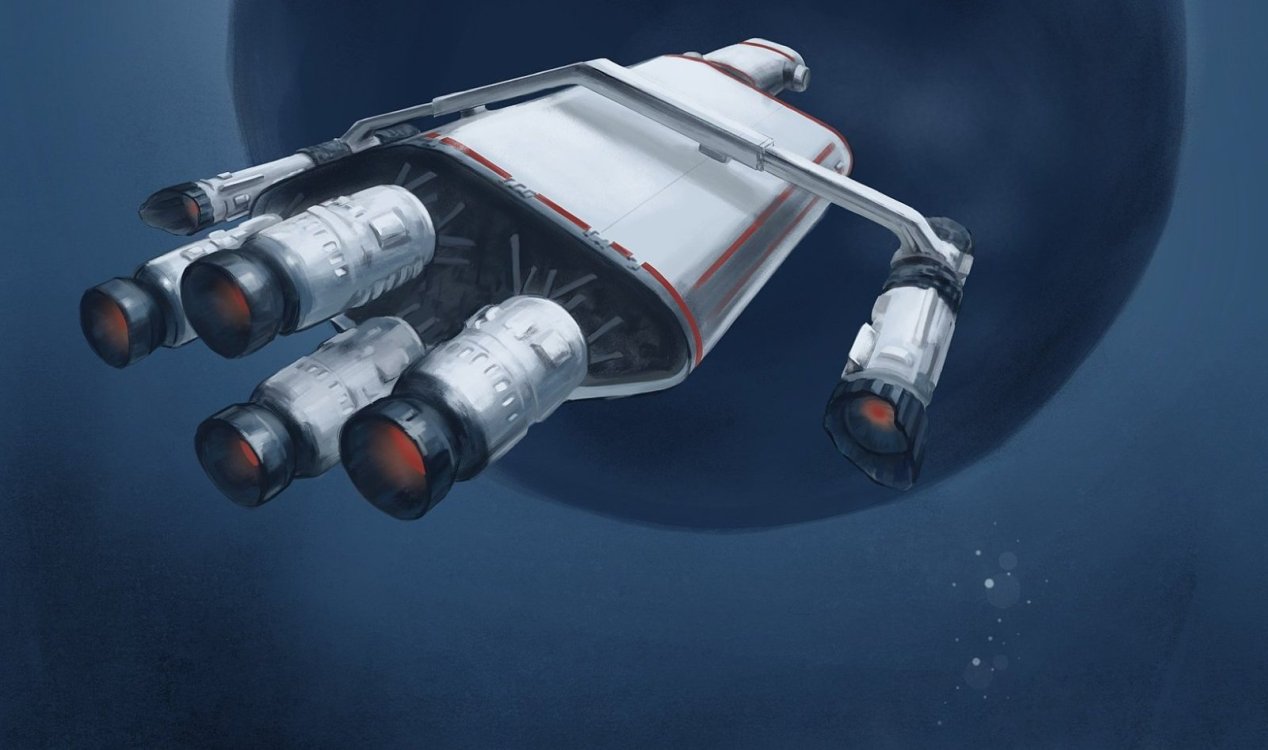
Image: Science Fiction Starship
Credit: Alorin / CC BY-SA 3.0 (adapted)
The only problem however is that Kepler-452b is a very long way away indeed.
Today's chemical rocket and ion-based propulsion systems enable us to send spacecraft to practically anywhere within our own solar system, but even NASA's New Horizons probe, which was traveling at an impressive 31,000mph when it streaked through the Pluto system last month, would take somewhere in the region of 20,000 years to travel just one light year.
At that speed it would take the probe a ridiculous 28 million years to reach Kepler-452b.
The upcoming 'NASA Evolutionary Xenon Thruster' (NEXT), which will be able to propel a probe through the solar system at up to 90,000 miles per hour, would still only reduce the travel time to 10.5 million years - still an incomprehendible amount of time for a trip through space.
Another possibility lies in harnessing the vast amounts of energy produced when matter meets anti-matter, an idea that has been explored in science fiction shows such as Star Trek.
Despite the fact that producing even one milligram of antimatter would cost $100 billion, in theory a propulsion system based on this principle could accelerate a craft up to 70% of the speed of light.
At this speed it would take the spacecraft 2,000 years to reach Kepler-452b.
Still a ridiculously long time - but perhaps in the future such a thing might just be possible.
Source: NBC News
Will we ever be able to visit 'Earth 2.0' ?
By T.K. RandallAugust 3, 2015
Image: Science Fiction Starship
Credit: Alorin / CC BY-SA 3.0 (adapted)
Kepler-452b, the most Earth-like world ever found outside our solar system, is 1400 light years away.
Last month astronomers rejoiced at the discovery of an extrasolar planet that has been unofficially dubbed 'Earth 2.0' - a rocky terrestrial world that orbits the same distance from its parent star as the Earth does from the sun - the habitable zone within which liquid water can exist on a planet's surface.The only problem however is that Kepler-452b is a very long way away indeed.
Today's chemical rocket and ion-based propulsion systems enable us to send spacecraft to practically anywhere within our own solar system, but even NASA's New Horizons probe, which was traveling at an impressive 31,000mph when it streaked through the Pluto system last month, would take somewhere in the region of 20,000 years to travel just one light year.
At that speed it would take the probe a ridiculous 28 million years to reach Kepler-452b.
Another possibility lies in harnessing the vast amounts of energy produced when matter meets anti-matter, an idea that has been explored in science fiction shows such as Star Trek.
Despite the fact that producing even one milligram of antimatter would cost $100 billion, in theory a propulsion system based on this principle could accelerate a craft up to 70% of the speed of light.
At this speed it would take the spacecraft 2,000 years to reach Kepler-452b.
Still a ridiculously long time - but perhaps in the future such a thing might just be possible.
Source: NBC News



The Unexplained Mysteries
Book of Weird News
AVAILABLE NOW
Take a walk on the weird side with this compilation of some of the weirdest stories ever to grace the pages of a newspaper.
Click here to learn more

Support us on Patreon
BONUS CONTENTFor less than the cost of a cup of coffee, you can gain access to a wide range of exclusive perks including our popular 'Lost Ghost Stories' series.
Click here to learn more

1 week
2 weeks
3 weeks
1 month


This week
This month
All time
| - | 1. | Pareidolia |
 |
2. | Loch Ness Monster |
|
3. | Ghost |
 |
4. | Yeti |
|
5. | Electronic Voice Phenomenon |
|
6. | Area 51 |
|
7. | Paranormal |
| - | 8. | Spirit Photography (Classic) |
|
9. | Orb |
| - | 10. | Storm Area 51 |


Top | Home | Forum
News | Columns | Encyclopedia


UM 11.3 Unexplained-Mysteries.com (c) 2001-2026
Terms | Privacy Policy | Cookies | Contact
News | Columns | Encyclopedia
UM 11.3 Unexplained-Mysteries.com (c) 2001-2026
Terms | Privacy Policy | Cookies | Contact