





Space & Astronomy
August 12, 2018


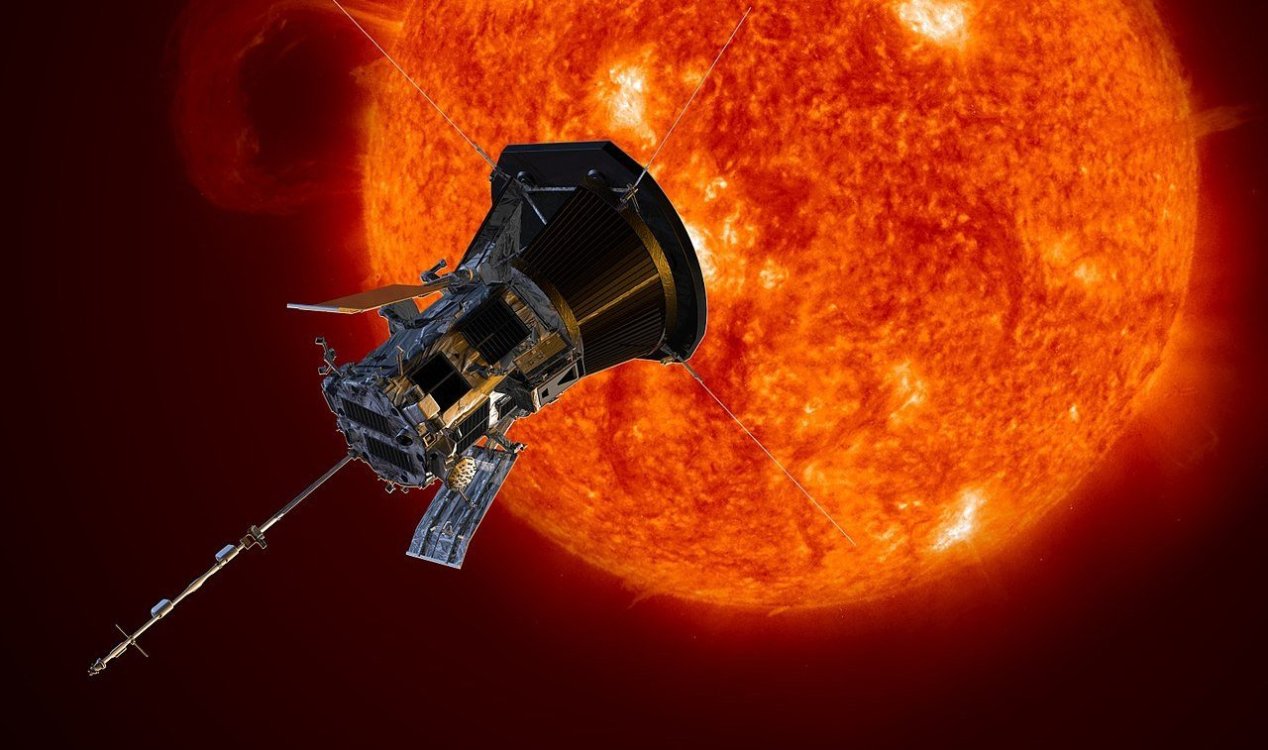
Image: Parker Solar Probe
Credit: (PD) NASA/Johns Hopkins APL/Steve Gribben
Its name is a tribute to American solar astrophysicist Eugene Parker who originally predicted the existence of the solar wind, something that at the time was considered 'crazy' by his peers.
"Wow, here we go!" he said. "We're in for some learning over the next several years."
One of the things that the spacecraft will be investigating is the fact that, counter-intuitively, the temperature is actually much, much hotter in the Sun's atmosphere than on its surface.
The probe will reach Venus in around six weeks and then the Sun a further six weeks after that.
Over the course of its seven-year mission it will complete a total of 24 loops around our star.
At its closest approach, it will venture a mere 3.83 million miles from the Sun's surface.
"I realise that might not sound that close, but imagine the Sun and the Earth were a meter apart," said scientist Dr Nicky Fox. "Parker Solar Probe would be just 4cm away from the Sun."
Source: BBC News
Parker Solar Probe has successfully launched
By T.K. RandallAugust 12, 2018
Image: Parker Solar Probe
Credit: (PD) NASA/Johns Hopkins APL/Steve Gribben
The probe, which is on a daring mission to the Sun, will become the fastest man-made object in history.
The spacecraft had been due to launch aboard a Delta IV rocket yesterday, however after being delayed due to a last-minute alarm, the launch took place earlier today instead.Its name is a tribute to American solar astrophysicist Eugene Parker who originally predicted the existence of the solar wind, something that at the time was considered 'crazy' by his peers.
"Wow, here we go!" he said. "We're in for some learning over the next several years."
One of the things that the spacecraft will be investigating is the fact that, counter-intuitively, the temperature is actually much, much hotter in the Sun's atmosphere than on its surface.
Over the course of its seven-year mission it will complete a total of 24 loops around our star.
At its closest approach, it will venture a mere 3.83 million miles from the Sun's surface.
"I realise that might not sound that close, but imagine the Sun and the Earth were a meter apart," said scientist Dr Nicky Fox. "Parker Solar Probe would be just 4cm away from the Sun."
Source: BBC News
Similar stories based on this topic:



The Unexplained Mysteries
Book of Weird News
AVAILABLE NOW
Take a walk on the weird side with this compilation of some of the weirdest stories ever to grace the pages of a newspaper.
Click here to learn more

Support us on Patreon
BONUS CONTENTFor less than the cost of a cup of coffee, you can gain access to a wide range of exclusive perks including our popular 'Lost Ghost Stories' series.
Click here to learn more

1 week
2 weeks
3 weeks
1 month


This week
This month
All time
| - | 1. | Pareidolia |
 |
2. | Loch Ness Monster |
|
3. | Ghost |
 |
4. | Electronic Voice Phenomenon |
|
5. | Yeti |
|
6. | Area 51 |
|
7. | Paranormal |
| - | 8. | Spirit Photography (Classic) |
|
9. | Orb |
| - | 10. | Storm Area 51 |


Top | Home | Forum
News | Columns | Encyclopedia


UM 11.3 Unexplained-Mysteries.com (c) 2001-2026
Terms | Privacy Policy | Cookies | Contact
News | Columns | Encyclopedia
UM 11.3 Unexplained-Mysteries.com (c) 2001-2026
Terms | Privacy Policy | Cookies | Contact