





Science & Technology
May 13, 2026


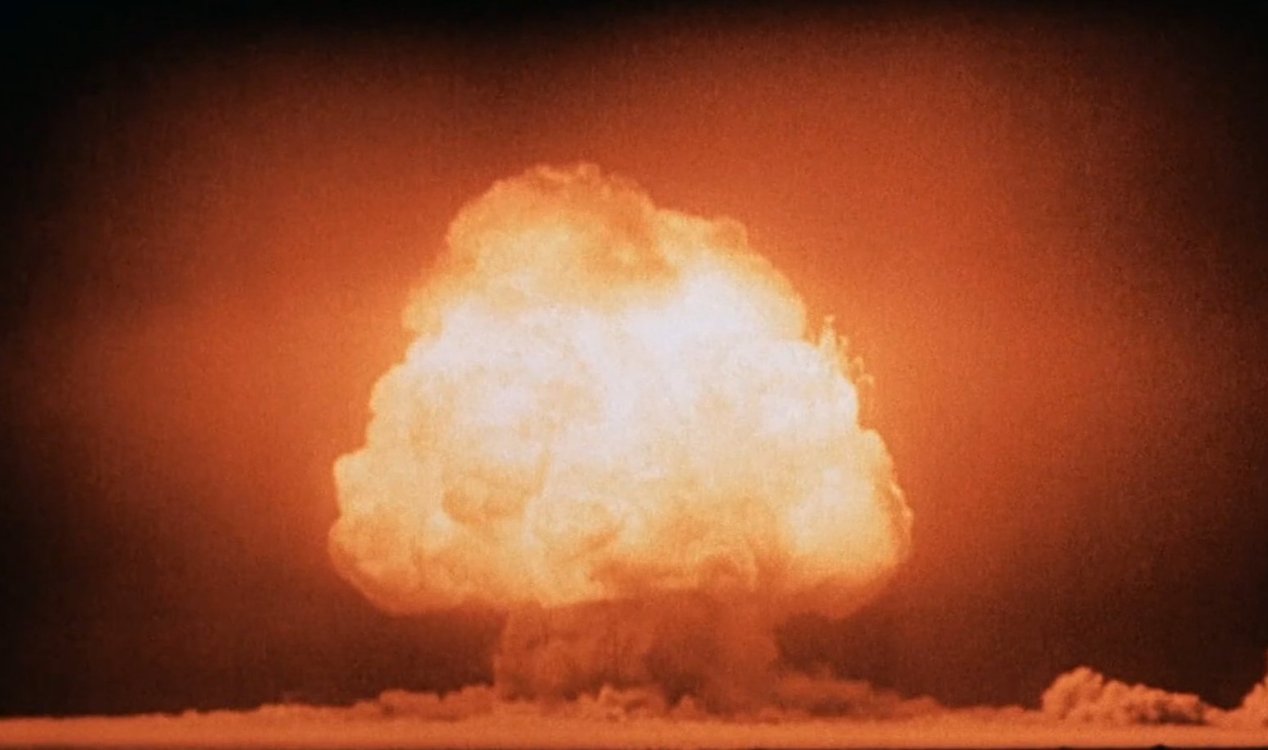
Image: Trinity Detonation
Credit: United States Department of Energy / (PD)
The 'Trinity' test, as it was known, was the first of many and with a yield of around 25kt, it had a profound effect on its immediate vicinity, the consequences of which scientists are continuing to discover, even today.
The latest such find - a mysterious crystal - was found within the resultant trinitite (a melted amalgamation of sand, copper and asphalt forged within the extreme heat of the blast).
Scientists believe that the unique conditions of the explosion - extreme temperatures, rapid cooling and immense pressures - created crystal structures found nowhere in nature.
The study was headed up by geologist Luca Bindi of Italy's University of Florence.
"Extreme, transient conditions produced by nuclear detonations can generate solid-state phases inaccessible to conventional synthesis," the researchers wrote.
"We report the discovery of a previously unknown calcium copper silicate type-I clathrate formed during the 1945 Trinity nuclear test; the first crystallographically confirmed clathrate identified among nuclear-explosion products."
The findings offer a unique look at some of the oft-overlooked consequences of nuclear war.
If one blast can do this to sand and asphalt, the effects of a large scale conflict would be unimaginable.
Source: Science Alert
'Impossible' crystal found at site of world's first nuclear weapons test
By T.K. RandallMay 13, 2026
Image: Trinity Detonation
Credit: United States Department of Energy / (PD)
Scientists have identified a peculiar crystal that, under normal circumstances, shouldn't be able to exist on Earth.
At 5:29 am on July 16th 1945, the skies southeast of Socorro, New Mexico lit up as the world's first ever nuclear weapon detonation changed the world forever.The 'Trinity' test, as it was known, was the first of many and with a yield of around 25kt, it had a profound effect on its immediate vicinity, the consequences of which scientists are continuing to discover, even today.
The latest such find - a mysterious crystal - was found within the resultant trinitite (a melted amalgamation of sand, copper and asphalt forged within the extreme heat of the blast).
Scientists believe that the unique conditions of the explosion - extreme temperatures, rapid cooling and immense pressures - created crystal structures found nowhere in nature.
"Extreme, transient conditions produced by nuclear detonations can generate solid-state phases inaccessible to conventional synthesis," the researchers wrote.
"We report the discovery of a previously unknown calcium copper silicate type-I clathrate formed during the 1945 Trinity nuclear test; the first crystallographically confirmed clathrate identified among nuclear-explosion products."
The findings offer a unique look at some of the oft-overlooked consequences of nuclear war.
If one blast can do this to sand and asphalt, the effects of a large scale conflict would be unimaginable.
Source: Science Alert
Similar stories based on this topic:



The Unexplained Mysteries
Book of Weird News
AVAILABLE NOW
Take a walk on the weird side with this compilation of some of the weirdest stories ever to grace the pages of a newspaper.
Click here to learn more

Support us on Patreon
BONUS CONTENTFor less than the cost of a cup of coffee, you can gain access to a wide range of exclusive perks including our popular 'Lost Ghost Stories' series.
Click here to learn more

1 week
2 weeks
3 weeks
1 month


This week
This month
All time
 |
1. | Loch Ness Monster |
|
2. | Electronic Voice Phenomenon |
 |
3. | Pareidolia |
|
4. | Ghost |
|
5. | Orb |
|
6. | Area 51 |
|
7. | Yeti |
|
8. | Spirit Photography (Classic) |
|
9. | Extraterrestrial |
|
10. | Bigfoot |


Top | Home | Forum
News | Columns | Encyclopedia


UM 11.3 Unexplained-Mysteries.com (c) 2001-2026
Terms | Privacy Policy | Cookies | Contact
News | Columns | Encyclopedia
UM 11.3 Unexplained-Mysteries.com (c) 2001-2026
Terms | Privacy Policy | Cookies | Contact