





Space & Astronomy
October 4, 2025


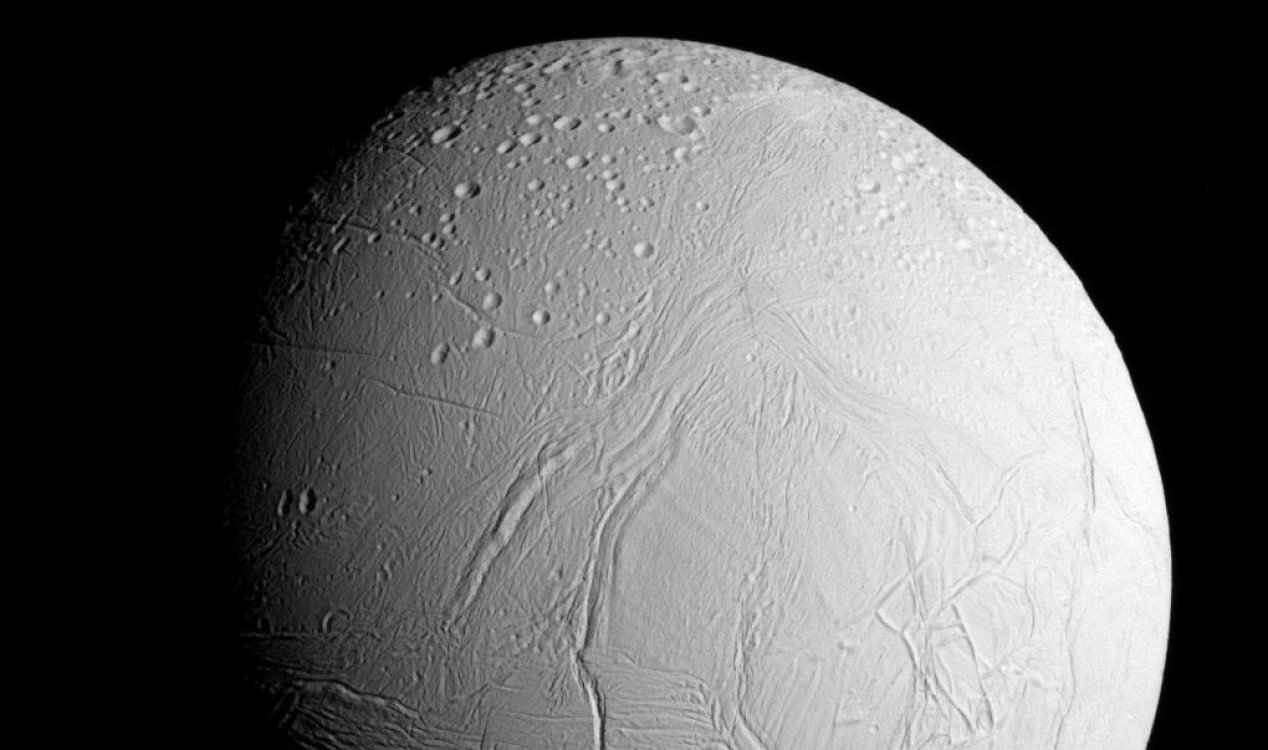
Image: Enceladus
Credit: (PD) NASA/JPL
Like its Jovian counterpart, this frigid world is believed to be home to an ocean of liquid water where primitive extraterrestrial life may thrive unseen even today in its freezing depths.
Back in 2005, NASA's Cassini spacecraft discovered that Enceladus was spewing some of the water from its ocean way up into space by way of powerful geysers from deep fissures on its surface.
By flying through some of the water from these plumes, the spacecraft was able to 'taste' this water directly and found promising organic molecules, including the potential precursors to amino acids.
Now, two decades on, a renewed analysis of the data it collected has revealed that Enceladus is home to a wider range of organic molecules than previously believed, while confirming that these have indeed come from the moon's interior and not from outer space.
"There are many possible pathways from the organic molecules we found in the Cassini data to potentially relevant compounds, which enhances the likelihood that the moon is habitable," said Nozair Khawaja of the Freie Universitat Berlin and the University of Stuttgart in Germany.
The findings add further credence to the notion that our own solar system may in fact be the best place to look for evidence of alien life.
"I think looking in our own back yard is a win-win," said ESA's Dr Jorn Helbert.
"Now if we discover that there are indeed signs of life [on Enceladus] that makes the search outside our solar system even more exciting."
"If we go and discover that despite all the conditions for habitability, we do not find any signs of life it means that we might need to rethink the definition of habitability or at least reconsider the likelihood of life emerging on a potentially habitable world."
Source: The Guardian
Organic molecules confirmed on Saturn's moon Enceladus
By T.K. RandallOctober 4, 2025
Image: Enceladus
Credit: (PD) NASA/JPL
Another world relatively close to home is now thought to be a promising place to look for signs of alien life.
The sixth largest moon of Saturn, Enceladus is an icy world with similarities to Jupiter's moon Europa.Like its Jovian counterpart, this frigid world is believed to be home to an ocean of liquid water where primitive extraterrestrial life may thrive unseen even today in its freezing depths.
Back in 2005, NASA's Cassini spacecraft discovered that Enceladus was spewing some of the water from its ocean way up into space by way of powerful geysers from deep fissures on its surface.
By flying through some of the water from these plumes, the spacecraft was able to 'taste' this water directly and found promising organic molecules, including the potential precursors to amino acids.
Now, two decades on, a renewed analysis of the data it collected has revealed that Enceladus is home to a wider range of organic molecules than previously believed, while confirming that these have indeed come from the moon's interior and not from outer space.
The findings add further credence to the notion that our own solar system may in fact be the best place to look for evidence of alien life.
"I think looking in our own back yard is a win-win," said ESA's Dr Jorn Helbert.
"Now if we discover that there are indeed signs of life [on Enceladus] that makes the search outside our solar system even more exciting."
"If we go and discover that despite all the conditions for habitability, we do not find any signs of life it means that we might need to rethink the definition of habitability or at least reconsider the likelihood of life emerging on a potentially habitable world."
Source: The Guardian
Similar stories based on this topic:



The Unexplained Mysteries
Book of Weird News
AVAILABLE NOW
Take a walk on the weird side with this compilation of some of the weirdest stories ever to grace the pages of a newspaper.
Click here to learn more

Support us on Patreon
BONUS CONTENTFor less than the cost of a cup of coffee, you can gain access to a wide range of exclusive perks including our popular 'Lost Ghost Stories' series.
Click here to learn more

1 week
2 weeks
3 weeks
1 month


This week
This month
All time
| - | 1. | Electronic Voice Phenomenon |
 |
2. | Pareidolia |
|
3. | Paranormal |
|
4. | Orb |
|
5. | Ghost |
 |
6. | Spirit Photography (Classic) |
|
7. | Yeti |
|
8. | Loch Ness Monster |
|
9. | Storm Area 51 |
|
10. | Area 51 |


Top | Home | Forum
News | Columns | Encyclopedia


UM 11.3 Unexplained-Mysteries.com (c) 2001-2026
Terms | Privacy Policy | Cookies | Contact
News | Columns | Encyclopedia
UM 11.3 Unexplained-Mysteries.com (c) 2001-2026
Terms | Privacy Policy | Cookies | Contact