





Space & Astronomy
January 16, 2026


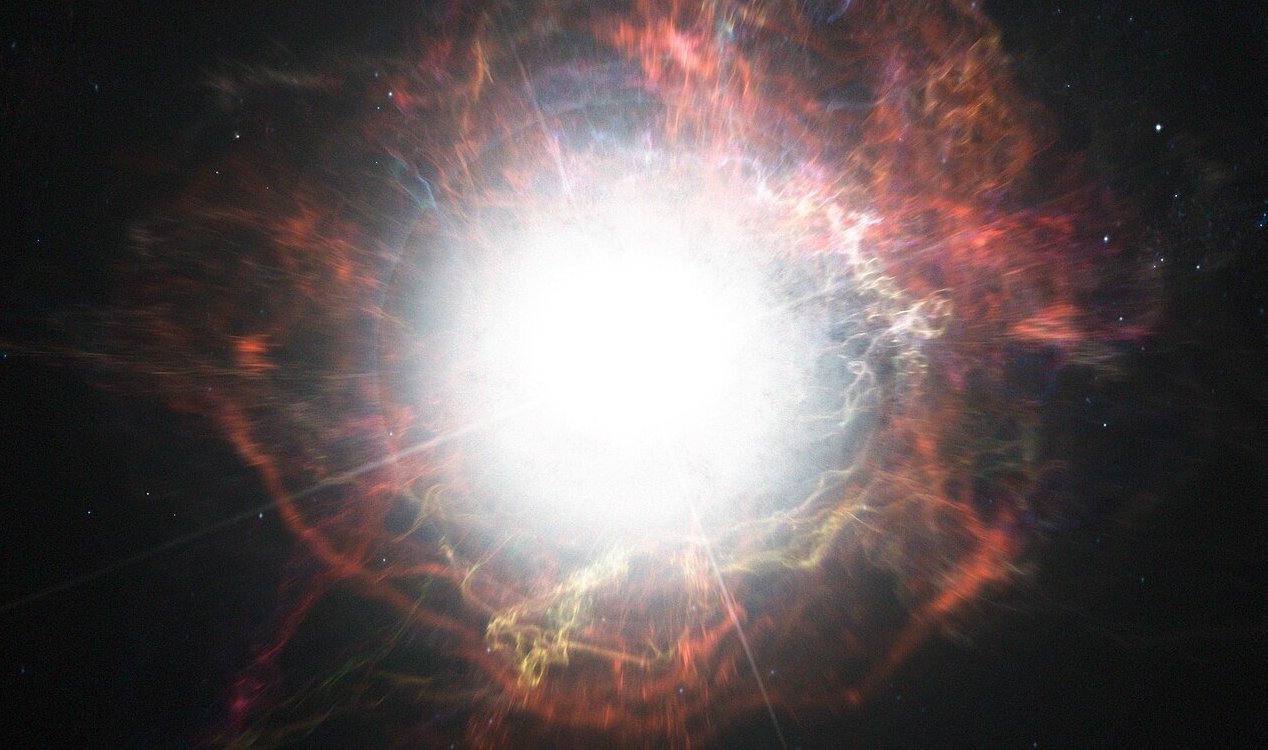
Image: Artist's Impression of the Dust Surrounding a Supernova Explosion
Credit: ESO/M. Kornmesser / CC BY 4.0 (adapted)
Now, after beginning its journey through the universe just 730 million years after the Big Bang, this burst of energy has finally been picked up here on Earth by astronomers.
Named GRB 250314A - it is thought to have originated from one of the earliest known supernova explosions ever detected - an echo of an event that occurred near the dawn of time.
It was picked up back in March by the Space Variable Objects Monitor (SVOM) satellite.
Some mystery still remains - such as why this particular supernova seems so similar to much more recent examples despite the expectation that early stars ought to be bigger and hotter than their later counterparts.
"There are only a handful of gamma-ray bursts in the last 50 years that have been detected in the first billion years of the universe," said study lead author Andrew Levan of Radboud University.
"This particular event is very rare and very exciting."
Source: Mail Online
Astronomers detect a mysterious signal from the beginning of time
By T.K. RandallJanuary 16, 2026
Image: Artist's Impression of the Dust Surrounding a Supernova Explosion
Credit: ESO/M. Kornmesser / CC BY 4.0 (adapted)
A signal lasting just 10 seconds is thought to have originated from one of the most distant sources ever detected.
13 billion years ago, a huge star ended its life in a catastrophic explosion of extreme proportions, sending a high-energy gamma-ray burst rippling through the cosmos.Now, after beginning its journey through the universe just 730 million years after the Big Bang, this burst of energy has finally been picked up here on Earth by astronomers.
Named GRB 250314A - it is thought to have originated from one of the earliest known supernova explosions ever detected - an echo of an event that occurred near the dawn of time.
Some mystery still remains - such as why this particular supernova seems so similar to much more recent examples despite the expectation that early stars ought to be bigger and hotter than their later counterparts.
"There are only a handful of gamma-ray bursts in the last 50 years that have been detected in the first billion years of the universe," said study lead author Andrew Levan of Radboud University.
"This particular event is very rare and very exciting."
Source: Mail Online
Similar stories based on this topic:



The Unexplained Mysteries
Book of Weird News
AVAILABLE NOW
Take a walk on the weird side with this compilation of some of the weirdest stories ever to grace the pages of a newspaper.
Click here to learn more

Support us on Patreon
BONUS CONTENTFor less than the cost of a cup of coffee, you can gain access to a wide range of exclusive perks including our popular 'Lost Ghost Stories' series.
Click here to learn more

1 week
2 weeks
3 weeks
1 month


This week
This month
All time
 |
1. | Loch Ness Monster |
 |
2. | Electronic Voice Phenomenon |
|
3. | Pareidolia |
| - | 4. | Area 51 |
| - | 5. | Phoenix Lights |
| - | 6. | Orb |
| - | 7. | Bigfoot |
| - | 8. | Stanton Friedman |
| - | 9. | Ghost |
|
10. | Storm Area 51 |


Top | Home | Forum
News | Columns | Encyclopedia


UM 11.3 Unexplained-Mysteries.com (c) 2001-2026
Terms | Privacy Policy | Cookies | Contact
News | Columns | Encyclopedia
UM 11.3 Unexplained-Mysteries.com (c) 2001-2026
Terms | Privacy Policy | Cookies | Contact